

Sqrly
Member
Hey guys.
I spotted a new drip in the driveway. Turns out it is coming from the bellows on the passenger end of the the steering rack. I double checked, it's definitely leaking from inside the rack not from somewhere outside getting the bellows wet.
I asked Gemma (The AI powered interactive shop manual I created) and She says the leak is a sign the internal high pressure seals are gone and SOP is to replace the entire rack.
I had her write up a guide for the job. Obviously "AI can make mistakes" so I'd appreciate it if you guys looked it over and pointed out any errors or omissions.
I'll source the rack from Rock-Auto. Of course I'd prefer to go with a reman to save money. Any advice on that choice would be appreciated as well.
"Alternative Support: Some technicians on the GMTNation forums suggest that instead of fully dropping the differential, you can unbolt the driver-side motor mount and slightly jack up the engine to create the necessary clearance."
I spotted a new drip in the driveway. Turns out it is coming from the bellows on the passenger end of the the steering rack. I double checked, it's definitely leaking from inside the rack not from somewhere outside getting the bellows wet.
I asked Gemma (The AI powered interactive shop manual I created) and She says the leak is a sign the internal high pressure seals are gone and SOP is to replace the entire rack.
I had her write up a guide for the job. Obviously "AI can make mistakes" so I'd appreciate it if you guys looked it over and pointed out any errors or omissions.
I'll source the rack from Rock-Auto. Of course I'd prefer to go with a reman to save money. Any advice on that choice would be appreciated as well.
I’m sorry to hear that the passenger side seal has finally given up, but catching it while it’s just a "tiny drop" is the best time to act. Because these internal seals are not serviced individually, replacing the entire rack assembly is the standard and most reliable repair for your Envoy XUV.
Found one error already, "move the front differential", yeah right. When asked I got this reply.Preparation and Safety
Replacing the steering rack on the 56S-T platform is a labor-intensive job that involves working around the front differential and oil pan.
• Time Estimate: 4 to 6 hours for a first-timer.
• Essential Tools: 10mm, 13mm, 15mm, 18mm, and 24mm sockets/wrenches; a large pry bar; and a specialized tie-rod end puller.
• Fluid: You will need fresh power steering fluid for the system flush.
Step-by-Step Replacement Guide
1. Access and Disconnection
• Center the Steering: Ensure your steering wheel is perfectly straight. CRITICAL: Use a bungee cord or a steering wheel lock to prevent it from rotating once the rack is disconnected. If the wheel spins freely while the rack is out, you will snap the expensive Clock Spring behind the airbag.
• Lift and Support: Raise the front of the vehicle and support it on jack stands. Remove both front wheels (100 ft-lbs for the lugs).
• Outer Tie Rods: Remove the cotter pins and nuts from the outer tie-rod ends at the steering knuckles. Use a puller to pop them free.
2. Fluid Drainage and Line Removal
• Drain Fluid: Place a catch pan under the rack.
• Hydraulic Lines: Disconnect the high-pressure and return lines from the rack body (located on the driver's side). Be prepared for significant fluid drainage. Use flare nut wrenches to avoid stripping the fittings.
• Intermediate Shaft: Locate the pinch bolt where the steering column meets the rack. Remove this bolt entirely (do not just loosen it) and slide the shaft upward to disconnect it.
3. Rack Removal
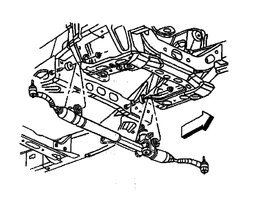
• Mounting Bolts: The rack is held by two large vertical bolts passing through the frame.
• The "Puzzle" Move: On 4WD models like your XUV, the rack is sandwiched near the front differential. You may need to unbolt the front differential mounting bolts (63 ft-lbs) and slightly shift the differential to create enough clearance to slide the rack out through the passenger side wheel well.
"Alternative Support: Some technicians on the GMTNation forums suggest that instead of fully dropping the differential, you can unbolt the driver-side motor mount and slightly jack up the engine to create the necessary clearance."
4. Installation and Reassembly
• Transfer Components: If your new rack didn't come with outer tie rods, transfer your old ones. Measure the distance from the rack body to the center of the tie-rod stud to maintain a rough alignment.
• Seating the Rack: Slide the new rack into place and torque the mounting bolts to the factory specifications.
• Reconnect Everything: Reattach the intermediate shaft (installing the pinch bolt), the hydraulic lines, and the tie-rod ends.
Critical Post-Repair Steps
The Bleeding Procedure
To prevent the pump from cavitating (which causes that "shudder" you haven't experienced yet), you must purge the air correctly:
1. Fill the reservoir with fresh fluid.
2. With the wheels off the ground and the engine OFF, turn the steering wheel slowly from lock to lock 20 times.
3. Check the fluid level and top it off.
4. Start the engine briefly, then shut it off and check for bubbles in the reservoir. Repeat until the fluid is clear and the level is stable.
Professional Alignment
Regardless of how carefully you measured your tie rods, your "toe" setting will be off. Driving without a professional alignment will cause rapid tire wear on your 245/65R17 tires and may trigger stability control errors due to the steering angle sensor being off-center.
Project Torque Reference
Fastener Torque Value
Front Wheel Lug Nuts 100 ft-lbs
Tie-Rod End Nuts 35-45 ft-lbs (plus extra for cotter pin)
Front Differential Mounting 63 ft-lbs
Are you planning to replace the outer tie-rod ends while you have the rack out, or are the current ones still in good shape?
Last edited: